
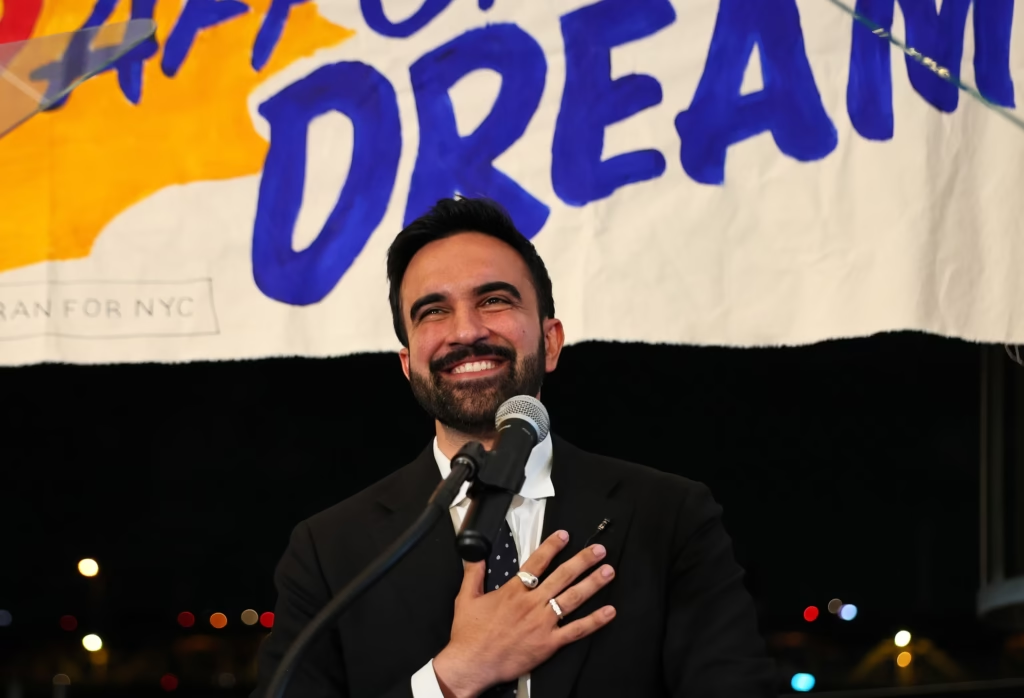


Who is Zaharan Mamdani
The case of Zaharan Mamdani, who began his political career as a member of the assembly in Queens, and emerged to be the center stage of one of the most closely observed mayoral campaigns in the history of America is a tale of generational politics, grassroots organizing, and the evolving demographic and ideological landscape of the largest city of America.
At 34, Mamdani has led a campaign based upon affordability, public transportation, labor rights and progressive politics and endured a level of scrutiny over his policy prescriptions and his background. It is based on this report, public documents, material of the campaigns and interviews that this profile explains why Mamdani is who he is, why he has been able to build up such political momentum, what he stands and why his victory has been so felt (and feared) across political boundaries.
Childhood and family life of Zaharan Mamdani
Zaharan Mamdani was born on October 18, 1991 in Kampala, Uganda. He was born and raised in Queens, New York, as his parents were immigrants to the United States. The key to his personal story and political identity is his family background, who were immigrants, raised in one of the most ethnically diverse boroughs of the city, and introduced to the community organizing at a young age. Mamdani has drawn on his multicultural background and immigrant status more than once, both in his own self-presentation and in the reporting of others, as the source of his policy perspectives and his expression to the world.
He went through the local public schools and even acquired degrees which led to his preparation both in the life of civic and the work of a public policy. Prior to his campaign to serve the New York State Assembly, he was involved in community campaigns and mobilization of the labor force -an apprenticeship of an organizer, which he has described as critical preparation of electoral politics. Both his biography and campaign literature in the Assembly portray his work with taxi drivers, transit riders and tenant associations.
Rise in politics: Assembly to nominee mayor of Zahraran Mamdani
In 2020, Zaharan Mamdani was elected to the New York State Assembly representing the 36th District that includes Astoria and Long Island City in Queens and was inaugurated in January 2021. At Albany he made his mark as an advanced politician, joining the Democratic Socialists of America, not to mention the regular Democratic caucuses and local unions. His bipartisan image was achieved by a combination of legislative campaigns and high profile street level activism, hunger strikes, rallies, and coalition campaigns that demanded mass debt relief and transit funding.
In 2025 Zaharan Mamdani launched a campaign as mayor which rapidly moved out of the underdog category to become a contender. He overwhelmingly conquered the Democratic primary and proceeded to beat an army that comprised of big names. According to reporters, his campaign was largely based on small dollar contributions, a robust social media platform and a volunteer organizing machine that brought together younger and first time voters. His field operation and digital strategy with the help of grassroots has earned him primary momentum which translated to wide electoral victory by political observers.
Priorities of platform and policy.
Zaharan Mamdani had campaigned on a clearly progressive ticket based on affordable cost and the development of public services. His most notable suggestions included rent freezes or aggressive rent stabilization plans, free or low-cost public transit plans (including offerings free buses), universal childcare, and a massive increase in social services funded by the city that were aimed at reducing the cost of living among working families. Zaharan Mamdani linked environmental and climatic policies with the goal of affordability arguing that sustainable investments would enable the generation of local jobs besides cutting household costs.
One of the key aspects of difference with more centrist opponents was the topic of public safety and the means of providing it. The strategy presented by Zaharan Mamdani focused on a community safety concept of the department, which would position outreach workers and social service professionals alongside the law enforcement in specific situations instead of just traditional policing. This proposal brought about controversies on the crime strategy, resource distribution and the weight on both community-based responses and police-based enforcement. Opponents stated that these reforms would weaken the time-tested policing strategies; advocates stated that it would lead to a decrease in recidivism and avert crises because of the resolution of the underlying causes.
Zaharan Mamdani has had a pro-union history on labor and wages, which has supported policy to raise wages, gig and service workers, and to broaden municipal procurement regulations to benefit living-wage vendors and contractors. He has pointed to his budget victories in the past – transit service budget cuts and debt relief campaigns – as an example of how he can turn activism into real money in the hands of working New Yorkers.
Political affiliations and identity.
Zaharan Mamdani is a democratic socialist and he has been supported by progressive leaders and organizations which have served to reinforce his message. National progressive leaders and local left-oriented elected officials came out publicly to support him both in the primary and general campaigns; the coalition enabled the consolidation of a youth base of voters and activists disillusioned with moderate democrats. Meanwhile, he was engaging the pragmatists by assuring them of detail-oriented programs to provide free and affordable services without upsetting the municipal budgets.
Even his running also highlighted fault lines as part of the larger Democratic coalition: individual labor unions and centrist personalities hesitated to offer their full-throated support or alternatively supported other candidates. Critics tried to paint Zaharan Mamdani as too radical a candidate to be elected to a city that values stability, but his electoral calculus (and the support of Gen Z, immigrant neighborhoods, and renters in particular) came out to score.
Ethical scandals and political criticisms.
Like most high-profile progressive individuals, Zaharan Mamdani is someone whose emergence came under strong criticism. He was subjected to continuous criticism within conservative media and political forces treating his position as being fiscally unsound or lax in his crime policy. The internationally resonant topics, especially his remarks on Middle East processes and relationships between Israel and Palestine became the subject of negative attacks by the opponents and external forces as well. The social media and other foreign online actors added to these lines of attack at times, which made an already struggling campaign a campaign with deep policy debates and identity politics.
President Trump and other leaders within the conservative wing of the country publicly attacked Zaharan Mamdani even before the general election, and the rhetoric of the leadership was sometimes Islam phobic or xenophobic in character. The response to that backlash was that the attacks demonstrated an expanding cultural and political divide on who is able to represent American cities today. Zaharan Mamdani responded that he increased his effort to connect with the grassroots and focused on his policy program and not on his own background.
Campaign plan: small donors and digital organizing.
The most obvious technical account of how Zaharan Mamdani succeeded in the election is that his campaign was technologically advanced digitally and concentrated on raising small-dollar donations. The campaign was good at utilizing social platforms to attract volunteers, increase endorsements, and position policy proposals in a way that could be shared and appealed to emotions.
That model – which other progressive campaigns had done in the previous few cycles – enabled a candidate with comparatively low name recognition outside of Queens to develop a citywide brand. Analysts cited the use of strategic voter-registration efforts, micro-targeting that is, messaging to the areas with large number of renters and young families and intensive use of grassroots canvassing in the last months of the race.
Governing issues and policy gap.
Political success involves only one thing, winning an election and the other one is implementation. Spending promises of free buses, universal child care, rent freezing mechanisms by Zaharan Mamdani, all that needs major sources of funds and administrative modalities.
The critics and even few budget analysts have cautioned that the programs may cost the government in billions in a single year and would involve state and federal partners, innovative methods of raising revenue (progressive taxation to local borrowing), and difficult bargaining with the labor and business communities. Counter to the argument made by the supporter that doing nothing about affordability would make the city more unaffordable and economically fragile, the supporter argued that the city is currently more and more unaffordable.
It will be essential to maneuver Albany and Washington. Although democratic control in most state and federal houses is the exception at different times, the details of local funding and the legal jurisdiction of rent legislation or even bus fare charges, are frequently the subject of complex intergovernmental negotiations. Zaharan Mamdani has known a little about Albany leverages in a legislative process, and one of the most challenging exercises he will undergo is to transfer an activist platform to sustainable municipal policy.
Electoral importance and needs.
The symbolism of Zaharan Mamdani triumph (or nomination, according to the reporting schedules) is on a number of fronts. He was one of the earliest Muslim and South Asian leaders to get to the apex office executive in the government of New York City, a position that had never been held by white and even older politicians. His triumph demonstrated the increased political power of immigrant populations, youthful voters, and multiethnic alliances which focus on the affordability rather than status-quo politics. The observers both in the United States and elsewhere at large framed the outcome as a harbinger of a new generation of urban leaders.
Meanwhile, his rise has exacerbated political divisions: moderate citizens fear losing the support of suburban swing voters; conservatives have realized that they have a chance to harness fear of insecurity and fiscal restraints; foreign observers have interpreted his victory through the lens of diaspora politics and world cultural arguments. New York politics have never been smooth politically in terms of geography but the tenure of Zaharan Mamdani will prove to be a tightly concentrated experiment as to whether progressive policy can be implemented at the municipal level.
Public image and personal persona.
Media profiles frequently call Zaharan Mamdani charismatic, disciplined and media savvy. He depicts an image of a very smooth but serious face public: able to talk the policy behind the scenes, at-home on the social stage, and capable of stitching personal account with politics. His campaign engagements were characterized by a combination of town halls that were community-driven and digitally charged moments to appeal to younger audiences. The reporters have observed the skill of his transition between the language of activism of grassroots movements and the language of policy wonks needed to persuade those who are skeptical and institutional allies.
Allies and endorsements
Zaharan Mamdani gained popularity among the progressive community and organizations by being endorsed by some of the most influential progressive leaders and organizations which assisted him in fundraising and reaching more people. Such endorsements gave him national exposure and assisted in attracting volunteers and donations off New York, and local endorsements by unions and local leaders gave his credibility within the local constituencies necessary to turn out. On the other hand the campaign was not going to be a dull affair since high profile moderates and conservatives opposed it.
What to watch next
The things that should be monitored upon by the observers in the event that Zaharan Mamdani assumes office include:
- Budget decisions and income policies — how are the administration going to finance the ambitious new programs without disrupting the bond ratings and the basic services in the city?
- Transit policy Transit Fare bus pilot programs – expand and stabilize subway funding?
- Crime and community safety — the application of community-based safety programs over traditional policing will become one of the hot spots.
- Housing policy – anything that works in rent will need the cooperation of the state or new local means.
- Maintenance of coalition- Can Zaharan Mamdani maintain his activist base and tread moderate messages to win the broad city electorate required to bring about structural changes?
Expert perspectives
According to political scientists and urban policy professionals interviewed by the press, the election of Zaharan Mamdani does not necessarily bring with it crucial policy change, but it gives a chance to redefine what municipal priorities are about. According to some scholars, cities that have limited tax bases need to be resourceful collaborators with the states and the federal government. Still other people envision the possibility of a real municipal-left policy laboratory – experiments with fare-free transit, community-owned groceries, or universal pre-K that can be extended to other cities. The implementation capacity, political coalition-building and the ability to measure the success of such experiments are of critical importance.
News reporting and framing of the narrative.
The international and national press has cast the candidacy of Zaharan Mamdani in many ways: as a generational change; as an experiment in progressive urban politics, as a representation of Muslim and South Asian voters; as a victim or indicator of the viability of U.S. centrist politics. The media has at times covered polarizing aspects of his faith, his views on foreign policy or his radical-sounding proposals while other media has covered his credentials as an organizer and his policy depth. So that profusion of frames has not only given supporters fuel but also provided opponents a rich source of attack advertisements and messages.
Final judgment: a mayor of a transforming city.
The story of (Zohran) Zaharan Mamdani, who started his career as an activist in a neighborhood of Queens and ended up at the doorstep of the highest office of New York City, is a portrayal of many of the most critical issues of discussions in modern urban America: who leads, who benefits, and who can afford a decent and loveable city. What was remarkable about his campaign was the ability to blend both grass-root excitement with policy aspiration:
the big question now is whether that energy can be converted into lasting policy achievements that make life more affordable without causing fiscal meltdown, and political outcry. Whether one agrees with his politics or not, the emergence of Zaharan Mamdani is a definite indication that urban electorate is evolving and that in the future, younger and more diverse electorates will define mayoral politics as much as the traditional political groups.
Sources
Associated Press
The Guardian
Read Also This: Still remembering Pierre Robert