


‘Quiet, piggy’: How President Trump attacks on women journalists has escalated
This is a continuation of several months of open insults and rejections directed at female journalists by President Donald Trump, an effort to marginalize the female press that campaign observers’ decree endangers the freedom of the press and endangers women in the press. The trend, involving the use of name-calling, gendered attacks and amplification by fans on social media, has been severely criticized by newsrooms, media freedom organizations and advocates of the media. Several press reports have reported that Trump attacks on women journalists have become a consistent theme of the communications strategy of the administration.
The recent weeks have witnessed incidents which have been shocking in their crudities. In one instance, during an exchange at the White House, the president was caught on tape saying he had never wanted to see a reporter as obnoxious as that one again and in another instance he called a Bloomberg newspaper reporter piggy and described a newspaper correspondent at the
New York Times as ugly inside and out when he criticized the coverage that he did not like. These are some episodes within an extended sequence of interactions which observers indicate reflect a readiness to single out women publicly and personally. The insult on Trump attacks on women journalists is frequently reiterated on social media affiliated to the president, which amplifies the impact of the insults.
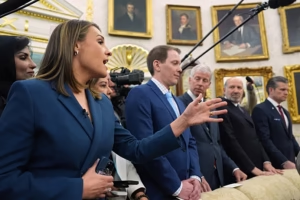
According to journalists and press activists, the language is not only vulgar, but it is also threatening as it naturalizes harassment. Organizations like PEN America, the National Press Club and others have cautioned that using names and gender as a means to single out reporters may end up the targeted online abuse, threats and the efforts to discredit the good reporting. The rights groups complain that long term individual assaults (particularly at high political office) reduce the standard of harassment and can send a message to sources not to talk to reporters. They argue that Trump attacks on women journalists do not only hurt feelings, but also alter the operating environment of female journalists.
The White House and his proxies have justified his comments as a blunt retaliation against the perceived media bias, as he is talking about the reporting he believes to be unjust, rather than the gender of the journalists. Opponents disown that argument, observing that most of the most vituperative statements have been repeated on women as other such coverage by male reporters has not evoked equal reactions. The gendered pattern in case after case is reflected in independent trackers and lists of timelines of the exchanges prepared by the outlets that list the incidents. Memes and posts that augment harassment often accompany Trump attacks on women journalists.
read also this: North Korea long-range missile base expansion alarms analysts
The pattern questions institutional responses, according to the views of legal scholars and press lawyers. Although the first amendment safeguards brutal criticism of the press, there are other checks provided by laws on workplace harassment and congress ethics in situations where speech goes beyond an intended intimidation. Media organizations have indicated that they will give aid to reporters who are threatened, but newsroom leaders also recognize the more practical problem of information safety of employees who are always in the limelight, especially women who are already disproportionately targeted by online abuse. Fears among the observers are that, further Trump attacks on women journalists may subdue investigative journalism and embolden rogue agents who aim to suppress news by intimidation.
The real-world consequences are obvious: a handful of female reporters have shared an increase in abusive online messages and threats following conversations with the president, and newsrooms are starting to increase their security and online-safety training. According to veteran editors, the most serious issue is not only saving the lives but also safeguarding values that allow the press to make the powerful accountable. Personal attacks are a way of punishing coverage, which encourages other newsroom security advisors to do the same when the leader of the country uses it to punish coverage. Trump attacks on women journalists are therefore being received as a personnel and a systemic problem.
Political backlash is starting to come through. Even as lawmakers in each party have been sharply divided on policy and coverage, they have occasionally spoken in scathing terms. Other Republicans who have been allied to it have minimized the importance, and packaged the incidents as partisan retaliation, and major press-freedom groups and most Democrats demanded a more explicit pledge not to attack journalists personally. Those controversies are part of a bigger argument concerning the connection between politics and a free press in a social media viral era. President Trump attacks on women reporters have so become an issue of discussion in congressional hearings, opinion articles and media compilations after trump attacks on women journalists.
Media ethicists urge caution in response: there are risks of overreacting and reinforcing the attacks but there are also risks of not acting and letting the attacks become normal. Some of the larger newsrooms declare that they will still deploy and secure reporters, in addition to recording the cases of official intimidation and asking platforms to implement harassment policies. They say that the aim is to keep the independence of reporting without making every presidential insult a spectacle. Nevertheless, due to the repetition and publicity of the attacks, Trump attacks on women journalists continue to be a focal point to the present media landscape, as well as something disturbing like trump attacks on women journalists.
With the dialogue between the White House and the media still going on, the interest groups believe accountability will be determined by whether an institution, be it social site or Congress or the White House itself, can contain specific harassment and uphold a promise of safety and dignity to journalists. As of yet, the books of record are filled with recurrent individual denunciations of the female gender in the media and an argument about the implications of those events to democracy. Lately, the Trump attacks on the women journalists have ceased to be a one-time event; it is a repetition that reporters, editors and the general audience are monitoring with great interest after trump attacks on women journalists.