
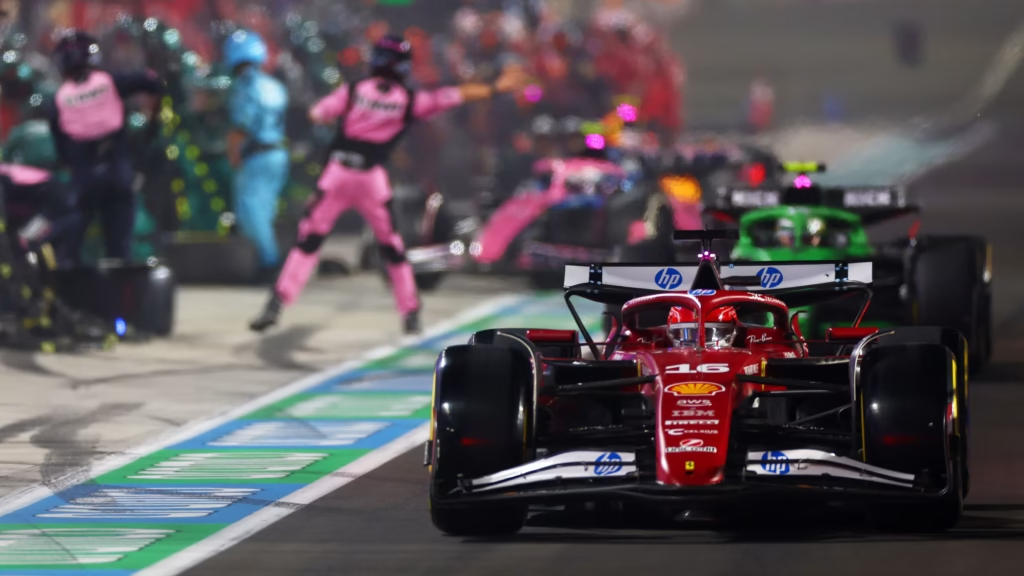


F1 Qualifying Time Takes Center Stage as 2025 Season Highlights Intense Grid Battles
F1 qualifying time is also back on the list of the most decisive factors influencing the result of the races as the Formula 1 World Championship of 2025 is going on. As automobiles become outfitted with the latest aerodynamic packages and car clubs continue to stretch the boundaries of the tire strategy, the significance of the Saturday qualifying session is being felt again as a driver is either fighting to win or merely fighting to make points on race day.
The importance of F1 qualifying time has been increasing especially because of the reduced performance difference between the leading five teams. Red Bull, Ferrari, McLaren, Mercedes and Aston Martin have all competed at an equal pace in 2025 making every millisecond count. The gap between pole and the third row may just be 0.4 seconds making qualifying one of the most dramatic moments of the weekend.
Why F1 Qualifying Time Matters in the 2025 Season
Contemporary Formula 1 takes knockout system of three stages: Q1, Q2, and Q3 whereby only the quickest drivers advance. Track evolution being a significant factor and performance of tires reaching a peak over a small range in temperature, quality F1 qualifying time has become a fine balancing act between the engineers and the drivers.
In Q1, teams are concerned with making safe to the next round without showing too much pace or endangering traffic. Q2 is the start of grid formation when the teams are trying their fastest laps with minimum possible error. However, it is Q3 where the magic occurs: ten cars struggle over a pole position and are frequently separated by a few milliseconds. There is enormous pressure on drivers to give the ideal lap and teams spend hours upon hours to analyze the telemetry in order to make the most out of every lap.
New Regulations put additional Pressure on Drivers.
In the 2025 season, the focus of the attainment of a competitive F1 qualifying time has been heightened by a few but significant alterations in regulations, especially with regards to tire allocation and the aspect of parc ferme. There is a reduced number of tire sets in the possession of teams over the weekend, and they need to be smarter when deciding when and how to push during the qualifying.
Also, the tighter conditions of parc ferme means the car setups will be fixed earlier, resulting in a difficulty of a team adapting to changing weather or track conditions. Due to this, a good qualifying place is now more than ever a crucial factor, especially in the circuits in which passing the leader is challenging, like Monaco, Hungary and Singapore.
Drivers who Provide Exemplary Performances.
The value of F1 qualifying time has been fully accepted by the drivers around the grid, with some of them having an outstanding performance this season. The pace of young talents, in particular, McLaren and Ferrari, has been impressive on one lap. Professional champions such as competitors of Red Bull and Mercedes still prove that they are masters of pressure.
Skill to create a perfect lap-time – even though the error bars are incredibly narrow at the high-speed turns – still is one of the most envied in motorsport. Some claim it is the most pure form of talent in the paddock, and the qualifying phase offers the lowest fuel load, the greatest track grip, and the sole purpose, which is to achieve the quickest possible speed.
Even a good F1 qualifying lap does not assure any victory, but it is much better. When there are only a few passing positions, being in the lead gives a tactic of leading in terms of tire usage, evading unnecessary crashes, and the speed of the race. Front-row starting teams tend to determine the speed of the pit-stop and the pace of the race.
Conversely, inexperienced drivers are compelled to use aggressive tactics as they seek to climb through the ranks with alternative tire compounds or on longer stints. Although the world can see spectacular comebacks, the 2025 season has provided evidence that the race results are still defined by the track position.
As the qualifying sessions have been made more dramatic and tighter, the world has become obsessed with F1 qualifying time. The activity in social media is highest on the Saturdays, and millions of people follow the updates on the timing of the live events and radio channels of the teams. The TV broadcasters have also improved their coverage as they provide better graphics, predictive lap-time appliances and real-time sector comparisons that further makes the pole-betterment more thrilling to the viewers.
The qualification time of Formula 1 keeps on gaining significance as the 2025 season advances. Since details of car proper adjustment to the boldness of the pilots taking the risks, qualifying is one of the most exciting parts of the sport. And as the performance difference dwindles and the competitions stiffen every millisecond on Saturday might be the difference between the winner and the loser on Sunday.
Read Also This: CDC hepatitis B vaccine schedule