
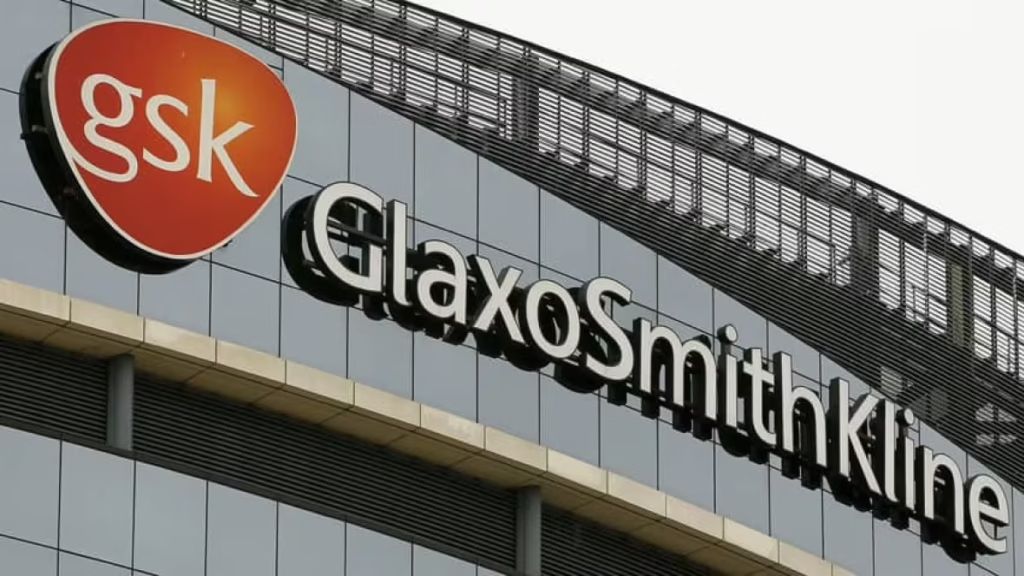
Emma Walmsley’s Leadership at GSK and the Road Ahead for Luke Miels
When it comes to leadership in the pharmaceutical industry, few names stand out as much as Emma. She became the first woman to lead a top global drug maker when she took over as CEO of GSK Plc in 2017. Nearly nine years later, Walmsley is preparing to step down, handing over the role to Luke Miels, a trusted executive who has been with GSK since 2017.
Her tenure was marked by big investments in vaccines, rebuilding GSK’s drug pipeline, and splitting off its consumer-health division into Haleon Plc. Yet, despite achievements, the share price underperformed compared to rivals like AstraZeneca. Now, all eyes are on Luke Miels to push GSK forward and deliver more blockbuster medicines.
Who is Emma Walmsley?
Emma began her career in marketing at L’Oréal before joining GSK in 2010. She quickly rose through the ranks, first leading the consumer healthcare division and then becoming CEO in 2017. At that time, she was relatively new to the world of pharmaceuticals, which sparked doubts among investors.
Still, Walmsley proved herself by showing strong decision-making and resilience. She focused on reshaping the company into a more research-driven organization, something GSK had struggled with in the past. Her role as the first female CEO of a global pharmaceutical giant also placed her in the spotlight, making her a symbol of progress in a male-dominated industry.
During her leadership, Emma worked to transform GSK into a science-led business. Some of her key moves included:
-
Investing heavily in vaccines: GSK became a leader in this space, including successful progress on the RSV vaccine.
-
Expanding the HIV business: Strengthening its portfolio of treatments and ensuring global reach.
-
Re-entering oncology: After years away from cancer research, GSK began investing again in oncology drugs.
-
Spinning off Haleon Plc: This allowed GSK to focus on pharmaceuticals and vaccines, while Haleon specialized in consumer health products.
-
Boosting research and development (R&D): Spending on R&D doubled under her leadership.
Walmsley also resolved long-standing legal disputes, including litigation over the heartburn drug Zantac in the U.S. Despite these steps, she faced criticism from some investors who felt the company wasn’t moving fast enough to compete with rivals.
The Appointment of Luke Miels
As Walmsley prepares to leave, GSK announced that Luke Miels will become CEO from January 1, 2026. He is currently the Chief Commercial Officer and has been central to the company’s success in vaccines and medicines.
Miels is not new to the industry. He has worked with big names such as Sanofi, Roche, and AstraZeneca. In fact, AstraZeneca once tried to block his move to GSK, leading to a legal dispute that was eventually settled.
Walmsley herself described hiring Miels as a “dream appointment,” highlighting his importance to the company. Over the years, he played a crucial role in shaping GSK’s drug pipeline, especially in oncology and specialty medicines.


Challenges Ahead for Luke Miels
Taking over from Emma won’t be easy. Luke Miels faces several challenges as the new leader of GSK:
-
Delivering blockbuster drugs: GSK needs new treatments to replace older drugs that are losing patent protection.
-
HIV drug competition: The company’s leading HIV medicine, dolutegravir, will face patent expiry by the end of the decade.
-
Boosting investor confidence: Despite improvements, GSK’s shares have fallen about 10% under Walmsley, while AstraZeneca’s value has more than doubled.
-
Balancing acquisitions and R&D: Experts suggest Miels must combine in-house innovation with smart acquisitions.
-
Maintaining momentum in vaccines: GSK’s RSV vaccine success must be followed by more breakthroughs.
According to analysts at Shore Capital, Miels has been “dealt a good hand.” The company is targeting over £40 billion ($53.7 billion) in sales by 2031, and his role will be to execute strategies already put in place.
Achievements Under Emma Walmsley
Looking back, Emma did make significant progress during her time:
-
Sales increased steadily, supported by a stronger vaccine and HIV business.
-
The consumer health unit was successfully spun off, creating Haleon Plc as a separate listed company.
-
R&D investment doubled, showing a renewed focus on science.
-
The oncology portfolio was rebuilt after years of absence.
-
Legal challenges, including the Zantac lawsuit, were resolved.
She also strengthened internal culture by pushing for diversity and innovation at GSK.
Market Struggles and Investor Pressure
Even with these achievements, Emma struggled to fully convince investors. A major turning point came when activist investor Elliott Management pushed GSK to bring in more pharmaceutical expertise at the top level.
While Walmsley survived the challenge, the criticism underlined a bigger issue: the company’s share performance. During her tenure, GSK’s shares dropped by around 10%. Meanwhile, AstraZeneca’s market value more than doubled, making the contrast sharper.
Analysts argue that the lack of late-stage results in the drug pipeline has been a major concern. Barclays analyst Emily Field noted that while GSK has many drugs in development, results from final-stage trials are still awaited.
Future Outlook for GSK
The big question now is whether Luke Miels can build on Walmsley’s foundation. His global experience and role in driving commercial success at GSK give him an advantage. Industry experts believe:
-
GSK doesn’t need a major strategy shift. Execution will be key.
-
The company is in a stronger position now than when Walmsley took over.
-
Focus on oncology, vaccines, and respiratory medicines will be crucial.
-
Selective mergers and acquisitions may strengthen its portfolio further.
If Miels succeeds in delivering blockbuster drugs and keeping investors confident, GSK could finally catch up with rivals.
Emma Walmsley’s nearly decade-long leadership at GSK has been a mix of achievements and challenges. She strengthened the company’s science base, expanded vaccines and HIV medicines, and restructured the business for future growth. Yet, her legacy is clouded by weak share performance compared to competitors.
Now, Luke Miels is set to take over in 2026. He inherits a company with stronger foundations, but the pressure is on to deliver new medicines that can drive GSK’s growth into the next decade.
As the pharmaceutical world watches closely, one thing is clear: Walmsley has reshaped GSK, and Miels must now prove he can take it to the next level.
References
-
GSK Plc official press release (September 2025)
-
Bloomberg Business Report on GSK leadership transition
-
Financial Times coverage of Emma’s tenure
Read Also This: Golfer Jake Knapp Who Passed Away at 28