
Chicago Snowstorm Triggers School Closings and Travel Chaos as Arctic Blast Hits the U.S.
November 10, 2025
Chicago is being hit by a major early season snowstorm with a very strong air mass in the Arctic region colliding with the hot waters of Lake Michigan. This mixture is generating heavy lake-effect snow, which is forcing the government to advise people against risky traveling and even closing schools.
What’s Happening and Why ( School Closings and Travel Chaos )
According to reports by the National Weather Service (NWS), a very thin yet very intense snow band of 8 to 10 miles would yield a snowfall of more than three inches per hour. The Chicago area is predicted to experience strong wind gusts of about 35mph with a near-zero visibility and some thundersnow.
Lake-effect snow Lake-effect snow is formed as a result of warm Arctic air passing over warmer water bodies resulting in thick and localized snow bands.
• The amount of snow that falls would be different block to block, there may be only a couple of inches of snow on some blocks and over a foot on others.
• It has already been reported at Chicago Midway Airport of heavy blowing snow and in northwest Indiana of 6 inches of snow with only more than two hours to go.
People are being encouraged to keep an eye on projections and keep an eye on swift alterations in circumstances. Closings can be made in the various districts in case of snow bands stalling over the densely populated places.


Impacts & Timeline
Timing:
Monday morning- Sunday night: Snow bands increase in intensity, along lake shore areas and suburbs.
• Peak impact: Monday morning traffic and the warnings will go further in the morning up to noon.
Snowfall & Travel Conditions:
• Projected amounts: 612 inches; portions of the lakeshore will get 1218 inches.
• Travel: NWS presents the conditions as dangerous or almost impossible.
• Block-to-block variability: Small snow bands imply that adjacent roads can differ in terms of snowfall by an enormous amount.
Cook County, eastern Will County and northern areas of the state of Indiana are affected by winter-storm warnings.
As the situation changes, several districts have declared surveillance over school shutdowns and late school start determinations.
The Unusually of this Snowstorm.
• Beginning intensity: Chicago gets an average of first measurable snow in November 18.
• Historical background: The city of Chicago does not get more than 10 snow in early November decades.
• Record possibility: The November snowfall of more than 10 inches that occurred last was in 1895.
• Effects of an arctic blast: Ice shivering mixed with a warm lake makes the atmosphere normally found in the mid-winter.
Central lessons to the Residents and Commuters.
• Travel recommendations: No unnecessary traveling; create additional commuting time.
• Safety considerations: Have snow brushes, de-icer, full tank of gas and an emergency kit.
• School checks: The parents must verify official announcements of school closings early Monday.
• Keep up to date: Check NWS updates and local authorities to track the updated conditions.
Authorities threaten school closures may be prolonged or new notices given in case snow bands block overcrowded neighborhoods.
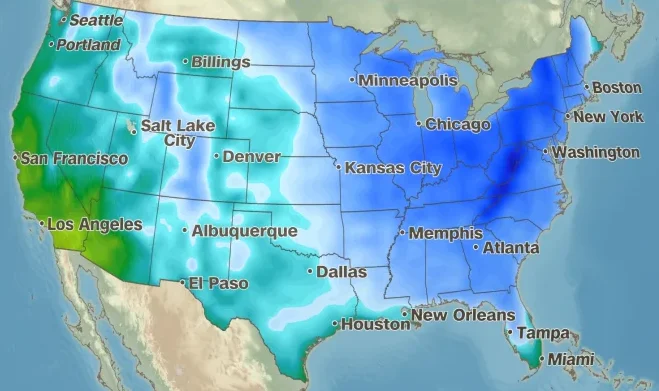
Greater Arctic Impact Nationwide.
The storm in Chicago is a part of a bigger Arctic blast which is striking the rest of the country:
• The Plains to the Southeast will be low with a sub-freezing low in Texas, Florida, and the Appalachians.
The largest cities such as Washington D.C. and New York might record the lowest mornings of the season.
Things may be questioned in Alabama, Mississippi, Georgia, Louisiana and Florida.
School closings are being discussed by other communities of the Midwest, which is preparing to face extreme cold and heavy snow.
The News to Follow in the Next Several Hours.
• Snow-band shifts: In case of stalling of the band, there might be some rapid accumulation in some of the neighborhoods.
• Blowing and drifting snow: Gusts up to 35mph could aggravate the travel conditions.
• Rare thunders now: Refers to very heavy snowfall within a short duration of time.
The residents should be encouraged to listen to warnings, stay at home unless there is an essential reason to do so, and to prepare to changing conditions.
Chicago is heading towards a possible historic snowstorm at the beginning of the season. As school shutdowns become a possibility, and travel restrictions continue to increase, local guidelines encourage adult residents to remain vigilant and pay attention to local news and take precautions. This storm shows how unstable the lake effect snow can be and why great care must be taken in case of extreme weather conditions during winter.
Read Also This: Massacres in Sudan