


Michael Burry Warns of AI Boom, Deregisters Fund during Short Bets.
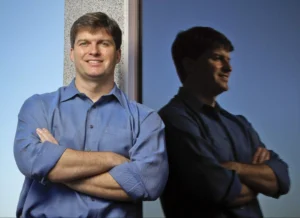
The hedge-fund manager, Michael Burry, a famous investor who predicted the 2008 housing crash, has made bold new moves that are causing commotion in the tech markets and raising eyebrows among the Wall Street. This week, Michael Burry declared the de registration of his company and doubled his contrarian position regarding the current AI exuberance, which again put him in the limelight.
A fund managed by Michael Burry
called Scion Asset Management, publicly registered in an official filing, indicated that it has deregistered with the U.S. Securities and Exchange Commission, a move that suggests that the firm may look to move out of a registered hedge fund and instead evolve into a private family-office structure. The de registration is accompanied by another one of Burry teasing a big disclosure on November 25.
What is behind the change in Michael Burry? The solution seems to be the boom -and possibly bubble- in artificial intelligence infrastructure companies, in particular those which he feels are mishandling the depreciation of costly hardware such as as chips and servers. Michael Burry has cautioned that big tech companies are overstating the depreciation lives and hence inflating income.
Mega-cap “hyperscaler” companies (including cloud computing and AI infrastructure companies) are purchasing high-end hardware (including hardware sold by Nvidia Corporation) that might have effective useful lives of 2-3 years, but the companies are amortizing it over much longer durations, e.g., 5-6 years. He approximates that the resultant understatement on depreciation may be in the 2026-2028 a figure of US 176 billion.
Michael Burry has done the same with his words: regulatory filings indicate about US$912 million put options against Palantir Technologies and US$187 million against Nvidia. His action indicates a strong belief that the appraisals in the AI trade could not be maintained and prone to a correction, and as Michael Burry put it, it is not only a time issue but also a problem of structural accounting and obsolescence risk.
Michael Burry has been unsparing in the posts both on the social media and in the public. In X (previously Twitter), he posted: Sometimes the winning strategy is to not play. He is gradually putting himself in the role of the voice of caution when most investors are still betting on the AI super-cycle as something that cannot be stopped. The bearishness of the tone of Michael Burry and the hype of the AI has drawn an extreme line.
The de registration of Scion can be used in more than one purpose. Michael Burry might wish to have less regulation, more discretion to make antithetical bets, or just minimize the publicity requirements. In any case, the timing is significant: deregistration occurs when Burry publicly changes to a family-office type of structure despite big bets.
Why then does the opinion of Michael Burry have anything to do now? Due to the fact that the expectations of AI companies in the market are astronomical, the number of capex, growth, and profit margins are already factored into the valuation. In case Burry is right in his claim that depreciation and hardware life are being underestimated, then stock price could be impacted negatively by the revision of earnings, or lower returns.
In the case of markets, the implications are high. Should the thesis of Michael Burry prove true, the huge AI infrastructures players may become disappointed in profits, investors may turn negative, and the wider growth-style trade (where many of the so-called Magnificent Seven companies fall) may be jeopardized. A single observer already compared the ongoing AI construction to the over-investment in fiber-optic networks by the dot-com bubble.
Nonetheless, there is the counterargument. The AI trade adherents say that hardware of older generations is still utilized and software and infrastructure can continue to grow even with hardware replacement cycles. However, Michael Burry maintains that the margin of error is decreasing.
To those who are involved in the investment-risk signal, the latest activity of Michael Burry serves as a reminder that the market stories evolve, frequently without noises, and big trends (such as AI) are susceptible to an accounting, technological, or timing shock. His deregistration of Scion may be also an indication of his assumption that the publicly-reporting vehicle is no longer suitable to the strategy in the future.
In a nutshell: Michael Burry is stirring ripples again – this time, by withdrawing his publicly traded investment vehicle, indicating his huge bets in what he believes are mis-priced AI infrastructure firms, and recommending markets to watch the present euphoria wash away. It is yet to be determined whether his contrarian perspective is going to come true or it is going to be too soon but his history ensures that his voice will be heard.
As Michael Burry himself insinuated: Tune in on November 25th – his next action can have even larger implications.
Read Also This: Apple and Issey Miyake Launch the Stylish “iPhone Pocket”